


Please fill out the form below to request a quote or to request more information about us. please be as detailed as possible in your message, and we will get back to you as soon as possible with a response. we're ready to start working on your new project, contact us now to get started.
What Is a VNA Forklift? VNA vs Reach Truck
2026-11-04
Meenyon
10
In warehouse operations, the choice of forklift can significantly affect storage density, throughput, safety, and operating cost. Two common options for space-constrained facilities are the VNA forklift and the reach truck. Both can work in tighter spaces than a conventional counterbalance truck, but they use different handling concepts and are suited to different layouts.
VNA stands for Very Narrow Aislenot Visible Narrow Aisle. This article explains what a VNA forklift is, how it works, how it compares with a reach truck, and what to consider when selecting equipment. Aisle widths, lift heights, speeds, and capacities vary by model, load, racking, floor condition, and local regulations, so final selection should be based on a site survey and manufacturer specifications.
What Is a VNA Forklift?
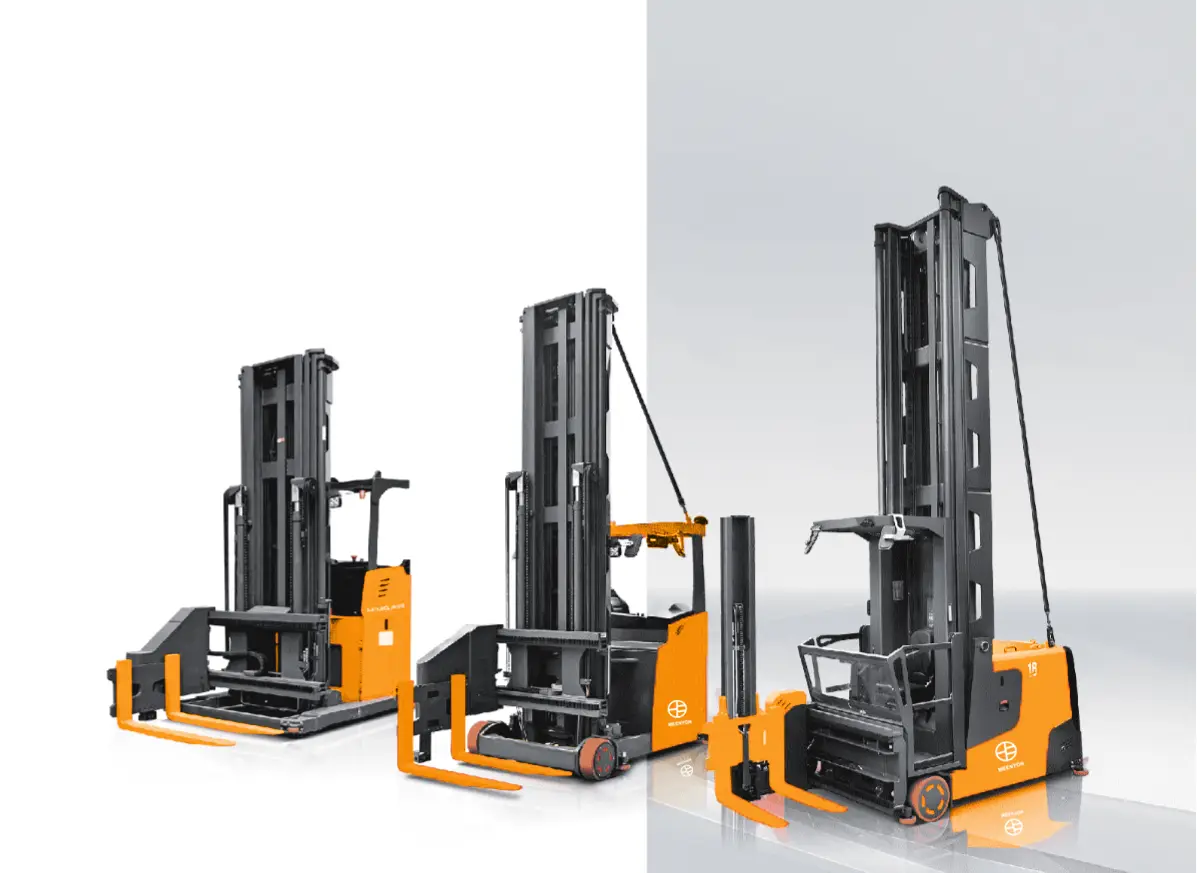
A VNA forklift is a lift truck designed for very narrow aisle operations. Rather than relying on a wide turning radius, VNA trucks typically use aisle guidancesuch as rail guidance or wire guidanceand a specialized mast, turret, or fork carriage that allows pallets to be stored and retrieved on both sides of the aisle without turning the whole chassis.
VNA is a category rather than a single design. It can include purpose-built turret trucks, man-up order pickers, and some articulated forklifts. Buyers should confirm the exact truck type, aisle requirement, lift height, and handling mechanism before comparing models.
How a VNA Forklift Works
- Guided aisle operation: Many VNA trucks run in guided aisles to maintain precise alignment and reduce damage risk.
- Rotating or traversing load handling: A turret head, rotating mast, or traversing fork carriage allows the forks to reach racking on either side of the aisle.
- Operator position: In many turret VNA trucks, the operator does not turn the whole truck; the mast or load-handling mechanism rotates. The exact operator position depends on the design.
- High-bay capability: VNA trucks are often used for high racking, but lift height and residual capacity must be checked for each model and load.
- Infrastructure requirements: VNA performance depends on floor flatness, aisle discipline, guidance systems, rack tolerances, and operator training.
A reach truck works differently. It uses a reach mechanismoften a pantographto extend and retract the forks to the rack. The truck remains in the aisle and does not normally rotate its chassis to serve both sides.
VNA Forklift vs Reach Truck
The table below summarizes common differences. The values are planning guidance only; exact requirements must come from the truck manufacturer and warehouse layout.
Use Cases
VNA Forklifts
VNA trucks are often a good fit when floor space is expensive or limited, racking is high, and the operation can maintain disciplined narrow aisles. They are commonly considered for high-density storage, full-pallet putaway and retrieval, and facilities with suitable floors and guidance. They are not automatically faster or safer; performance depends on layout, training, maintenance, and the specific truck design.
Reach Trucks
Reach trucks are widely used for medium-height racking and general pallet handling where aisles can accommodate a reach mechanism. They can be a practical choice for warehouses that need flexible pallet handling without the infrastructure and aisle discipline often required by VNA operations. They are generally less suited to very high-bay, very narrow-aisle storage than purpose-built VNA turret trucks.
Selection Checklist
Before choosing between a VNA forklift and a reach truck, review:
- Aisle width, rack layout, and building columns
- Required lift height and load weight at height
- Pallet types and load stability
- Throughput targets and task mix
- Floor flatness and guidance requirements
- Safety policies, operator training, and aisle discipline
- Service network, parts availability, and maintenance capability
- Total cost of ownership, including infrastructure and space savings
Meenyon VNA Forklift Advantages
Meenyon specializes in VNA forklifts and positions its products around efficient narrow-aisle operation, ergonomic design, and service support. Its stated advantages include:
- Advanced control and steering systems intended to support smooth, precise operation
- Ergonomic operator design for comfort and productivity during repetitive tasks
- Stability and precision for safe load handling in narrow aisles
- Efficient cycle-time potential through truck design and control systems
- Cost-effective operation through efficient design and maintenance planning
- Comprehensive support, including training, maintenance, and after-sales service
These are product-positioning claims and should be verified against model-specific specifications, aisle requirements, load charts, service coverage, and references for the intended application. A VNA truck is a major investment, so buyers should request a site survey and compare total cost of ownership rather than initial purchase price alone.
Conclusion
VNA forklifts and reach trucks solve different warehouse challenges. VNA trucks can help maximize storage density and vertical space in very narrow aisles, but they require suitable floors, guidance, aisle discipline, and operator training. Reach trucks offer flexible pallet handling in wider aisles and are often a practical choice for medium-height racking.
The right decision depends on the warehouse layout, load profile, throughput targets, safety requirements, and total cost of ownership. Meenyons VNA forklifts are worth evaluating where high-density, narrow-aisle storage is the priorityprovided the selected model is confirmed against the sites actual aisle, rack, floor, and load requirements.
GET IN TOUCH WITH Us
Copyright © 2026 Jiaxing Meenyon Green Energy Technology Co., Ltd. - www.meenyon.com | Sitemap