



Please fill out the form below to request a quote or to request more information about us. please be as detailed as possible in your message, and we will get back to you as soon as possible with a response. we're ready to start working on your new project, contact us now to get started.
Why a 3 Wheel Forklift Truck Is the Best Choice for Narrow Aisles
2026-11-02
Meenyon
46
Warehouse teams face constant pressure to move more pallets in less space without compromising safety. Narrow aisles, dense racking, and mixed pedestrian traffic make equipment selection especially important. A 3-wheel forklift truck can be a strong option for constrained indoor operationsbut only when the trucks wheel layout, capacity, aisle requirements, and duty cycle are matched to the actual facility. This guide explains what 3-wheel forklifts are, where they perform well, and how to evaluate Meenyon models with verifiable data rather than generic claims.
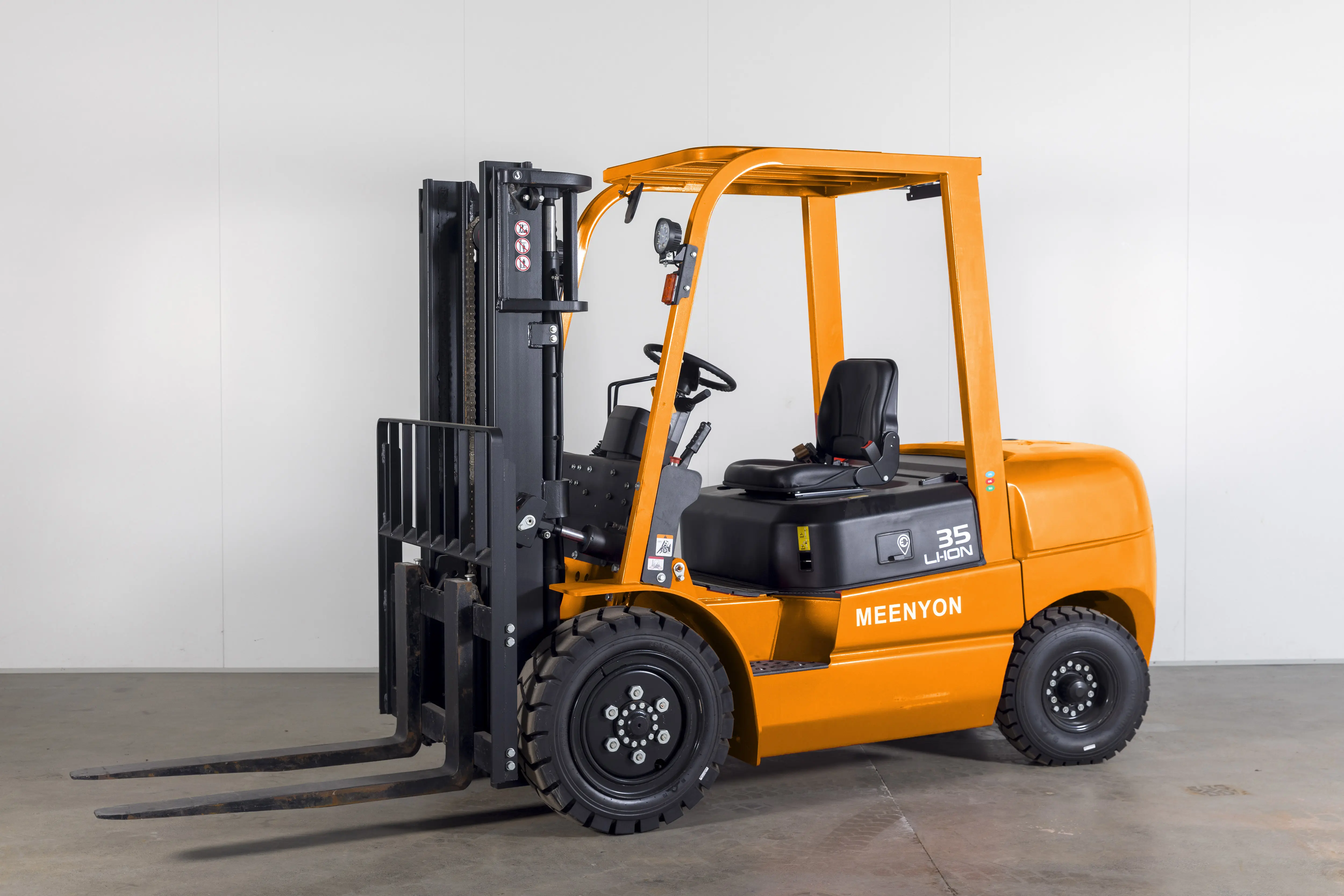
What Is a 3-Wheel Forklift Truck?
A 3-wheel forklift truck is a counterbalance forklift supported at three points. In common warehouse electric models, the layout is often two front load wheels and one rear steer wheel. However, wheel arrangement, drive position, and steering design vary by manufacturer and model. Some trucks use front-wheel drive; others use rear-wheel drive or dual drive motors. Some use a single rear steer wheel; others use different steering geometries.
Because of this variation, buyers should not assume that every 3-wheel forklift has the same front steering, rear drive layout. Always confirm the drive and steer configuration on the model-specific datasheet.
Key Features to Verify
- Steering and drive layout: Identify which wheel steers, which wheels drive, and how the system behaves on ramps, wet floors, and tight turns.
- Turning radius and right-angle stacking: These measurements matter more than the generic tight turning claim. Ask for the manufacturers aisle-width chart.
- Capacity: Confirm rated capacity at the actual load center and lift height. Capacity decreases as load center distance and lift height increase.
- Power system: Most indoor 3-wheel forklifts are electric. Check battery voltage, capacity, charger requirements, and available charging time.
- Safety features: Confirm lights, alarms, mirrors, speed control, emergency stop, operator restraint, and any pedestrian-awareness options.
Why Three Wheels Matter in Narrow Aisles
A 3-wheel forklifts main advantage is its compact turning envelope. With fewer support points and a compact chassis, many 3-wheel models can turn more tightly than comparable 4-wheel forklifts. That can reduce required aisle width and improve pallet-handling productivity in dense storage areas.
However, 3-wheel does not automatically mean more stable or lower cost. Stability depends on the trucks stability triangle, load center, lift height, tire type, floor condition, speed, and operator behavior. Cost depends on battery type, energy rates, maintenance practices, utilization, and service support. These factors should be checked model by model.
3-Wheel vs. 4-Wheel Forklifts: A Qualified Comparison
The practical conclusion is not that one design is universally better. A 3-wheel forklift is often a good fit for tight indoor aisles, while a 4-wheel forklift may be preferable for heavier loads, outdoor surfaces, or applications where a larger stability margin is required. The right choice depends on measured aisle dimensions and operating conditions.
Narrow-Aisle Benefits and Limits
Maneuverability in Tight Spaces
A compact 3-wheel counterbalance truck can often make sharper turns and work in tighter right-angle stacking situations than a comparable 4-wheel truck. This can improve pallet flow in existing buildings where widening aisles is expensive or impossible.
The limit is that maneuverability must be proven with the actual rack layout. A truck that turns tightly empty may behave differently with a load, at lift height, or on uneven flooring.
Safety and Stability
Three-wheel forklifts use a stability triangle. Operators must understand that capacity is reduced when the load is carried far from the carriage or lifted high. Safety also depends on proper training, pre-shift inspections, speed limits, pedestrian separation, mirrors, alarms, and load backrests.
A 3-wheel design should not be described as universally safer or less stable than a 4-wheel design. The correct comparison uses the capacity chart, intended lift height, load center, floor conditions, and local safety requirements.
Cost-Effectiveness Over Time
Electric 3-wheel forklifts can reduce indoor emissions and may lower fuel-related costs compared with internal-combustion trucks. But total cost of ownership includes:
- Purchase or lease cost
- Battery and charger cost
- Energy consumption
- Maintenance and parts
- Downtime and productivity loss
- Operator training
- Residual value
A lower purchase price does not guarantee lower lifecycle cost. Ask for energy-consumption estimates, service intervals, battery lifecycle data, and warranty details.
Specifying a Forklift for the Aisle, Not Just the Truck
Before comparing brands, measure the facility and define the duty cycle:
- Measure aisle width at the narrowest point, including rack uprights, doorways, and pedestrian zones.
- Calculate right-angle stacking requirements using the manufacturers aisle-width chart.
- Confirm load weight and load center for the most demanding pallet.
- Check lift height and derating at that height.
- Review floor conditions, ramps, dock transitions, and battery-changing space.
- Confirm local safety rules for aisle width, speed, pedestrian traffic, and operator training.
A forklift that fits the aisle but cannot handle the load at height is not a workable solution.
Evaluating Meenyon 3-Wheel Forklifts
Meenyon offers 3-wheel forklift trucks positioned for tight-aisle operations. Because specifications vary by market, model, and configuration, buyers should request current datasheets and verify the following points directly.
Meenyon Model Verification Checklist
- Drive and steering layout: Confirm whether the model uses front-wheel drive, rear-wheel drive, or another configuration, and which wheel steers.
- Capacity chart: Request rated capacity at the intended load center and lift heightnot just the headline capacity.
- Aisle-width data: Ask for turning radius and right-angle stacking aisle requirements for the exact model and tire type.
- Battery and charging: Confirm battery capacity, charger compatibility, charging time, and whether opportunity charging is supported.
- Ergonomics and controls: Check operator compartment space, control layout, visibility, and entry/exit.
- Safety options: Confirm availability of alarms, lights, mirrors, speed limiting, pedestrian-awareness features, and emergency stop.
- Customization: Ask which options are factory-approved, such as lift height, cab design, and safety packages.
- Warranty and service: Review warranty length, coverage exclusions, service-network coverage, parts lead times, and local dealer support.
- References: Request references from operations with comparable aisle dimensions, load weights, lift heights, and duty cycles.
Meenyons product literature may highlight ergonomic operator stations, electro-hydraulic steering options, customizable safety features, and service support. These are useful starting points, but they should be confirmed against the current model datasheet and, where possible, a site demonstration.
Implementation Metrics That Matter
To evaluate whether a 3-wheel forklift improves operations, measure before and after implementation:
These measurements are more useful than generic claims about increased efficiency or improved safety.
Standards and Documents to Check
Forklift selection should align with applicable standards and local regulations. Depending on the market, relevant references may include:
- OSHA 29 CFR 1910.178 for powered industrial trucks in the United States
- ANSI/ITSDF B56.1 for industrial truck safety
- ISO 3691-1 for industrial truck safety requirements
- Manufacturer datasheets, capacity plates, and aisle-width charts
- Local warehouse safety and pedestrian-traffic regulations
Conclusion
A 3-wheel forklift truck can be an effective solution for narrow aisles when its turning envelope, capacity, stability, and power system match the real operating conditions. The key is to verify model-specific data rather than rely on broad claims.
Meenyon 3-wheel forklifts are worth evaluating for tight-aisle operations, provided buyers confirm drive and steering layout, capacity at load center and lift height, aisle-width requirements, battery performance, safety features, warranty coverage, and service support. With measured aisle data, a clear duty cycle, and verifiable references, warehouse teams can choose a 3-wheel forklift that supports productivity, safety, and long-term cost control.
Table of Contents
GET IN TOUCH WITH Us
Copyright © 2026 Jiaxing Meenyon Green Energy Technology Co., Ltd. - www.meenyon.com | Sitemap